
Play Triple Diamond Now!
Home → Bonus Features
Triple Diamond Bonus Features
Bonus features of Triple Diamond
The theoretical Return to Player for this IGT slot is 95.06%, which establishes a house edge of 4.94% over extended play sessions. This percentage indicates that the game retains nearly five percent of all wagered funds, meaning players should expect slower bankroll depletion compared to higher RTP titles. The low volatility setting further stabilizes these returns by distributing wins more frequently, albeit in smaller amounts than high-variance alternatives. Consequently, beginners can manage their session budgets more predictably without experiencing drastic swings in their account balance during typical gameplay.
Free spins round
Triple Diamond does not include a free spins round or any bonus round feature within its standard gameplay mechanics. This absence contrasts sharply with modern video slots like Wolf Run from IGT, which offer complex secondary games to extend engagement. Players seeking extended playtime through complimentary spins must look elsewhere, as this classic title relies entirely on base game volatility for entertainment value. The lack of such features means every spin consumes real credits directly, requiring careful bankroll management to sustain longer playing sessions effectively.
Trigger conditions
Since there are no bonus rounds, specific trigger conditions for free spins do not exist for this particular IGT slot machine. Unlike Wolf Run, which requires landing three or more scatter symbols to activate its bonus phase, Triple Diamond operates solely on linear payline hits. Beginners might mistakenly search for special symbols that unlock extra rounds, but only standard wilds and matching symbol combinations yield payouts. Understanding this distinction prevents confusion when analyzing paytables, ensuring players focus on the core mechanics rather than chasing non-existent bonus triggers.
Retriggers and extensions
The concept of retriggering or extending bonus features is irrelevant because no such features are present in the Triple Diamond slot design. While games like Wolf Run allow players to retrigger free spins to add more rounds to their session, this classic title offers no such mechanism. Every outcome is determined instantly by the reels stopping, with no accumulation of credits toward future bonus events. This simplicity reduces cognitive load for beginners, who do not need to track complex multipliers or bonus states across multiple spins.
Multiplier mechanics
The maximum win cap for Triple Diamond is 1199x the total bet, achieved through the wild multiplier mechanics available on the reels. The Triple Diamond wild substitutes for all symbols and applies multipliers up to 9x when appearing on winning combinations. This mechanic significantly boosts potential payouts on single spins, contrasting with the medium volatility of Wolf Run which caps at 1000x. Beginners should note that these multipliers apply to the final line win, making each successful spin potentially more valuable than the base stake amount.
Triple Diamond: key facts
| Parameter | Value |
|---|---|
| Game | Triple Diamond |
| Studio | IGT |
| RTP | 95.06% |
| House edge | 4.94% |
| Volatility | low |
| Max win | 1199x |
| Reels | 3 |
| Paylines / ways | 9 |
Bonus buy option
Triple Diamond by IGT does not include a bonus buy feature, as the game relies on its classic 3x3 reel layout and straightforward mechanics without complex unlockable stages. This absence aligns with its low volatility profile, ensuring that outcomes are determined entirely by standard spins rather than purchased shortcuts or premium entry fees. Players seeking immediate access to special modes will find this title lacks such functionality, focusing instead on consistent base game engagement through wild substitutions.
The lack of a bonus buy option is consistent with IGT's design for this specific slot, which prioritizes steady returns over high-risk premium features. Without an option to purchase extra spins or multipliers, the gameplay remains accessible to beginners who prefer predictable pacing over expensive side transactions. This approach supports the theoretical return rate of 95.06%, keeping the house edge at a manageable 4.94% for long-term play.
Unlike White Orchid which offers different structural possibilities, Triple Diamond maintains its simplicity by excluding any paid entry mechanisms for enhanced gameplay phases. The maximum win potential of 1199x is achieved solely through natural symbol alignment during regular spins, emphasizing skill-free chance over financial investment in features. This structure ensures that every spin contributes equally to the overall experience without the pressure of recovering a feature purchase cost.
Special mechanics of this title
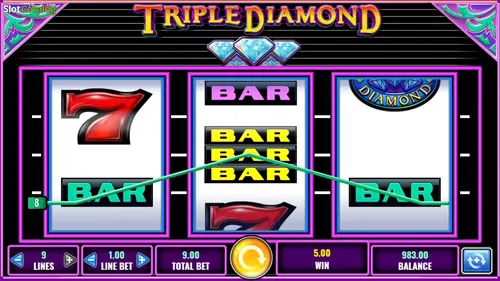
Triple Diamond features a classic 3x3 reel layout with exactly nine paylines, distinguishing it from the five-reel structure found in Da Vinci Diamonds. This compact grid design focuses on simplicity and direct symbol matching across the central row. Players must align three identical symbols to trigger a win, relying on the wild symbol for assistance. The absence of complex bonus rounds ensures that every spin contributes directly to the base game outcome without distraction.
The Triple Diamond wild symbol substitutes for all other icons on the reels, significantly increasing the probability of forming winning combinations. Unlike many modern slots, this feature does not come with multipliers during the base game unless the wild itself is part of the win. Consequently, the payout depends entirely on the specific symbol matched by the wild or the natural alignment of three matching icons. This mechanic creates a straightforward path to rewards without hidden variables.
Maximum wins are capped at 1199 times the total bet amount, which limits the potential upside compared to high-variance alternatives like Da Vinci Diamonds offering 5000x. This cap applies regardless of whether the win involves wild multipliers or standard symbol matches. Players should note that there is no cash-out button as this is a slot, not a crash game, meaning outcomes are determined solely by the RNG. The fixed nature of the max win provides predictable risk parameters for bankroll management.
How the studio built the maths
IGT designed Triple Diamond with a theoretical Return to Player (RTP) of 95.06%, establishing a house edge of 4.94% over extended play sessions. This percentage represents the average return per hundred euros wagered across hundreds of thousands of spins, rather than a short-term guarantee. The low volatility setting ensures frequent but smaller payouts, contrasting with the medium volatility of titles like Da Vinci Diamonds. Such a configuration suits players seeking longer session durations with reduced variance in their bankroll fluctuations.
The mathematical model relies on a simple probability distribution across the nine paylines, where each spin has an equal chance of landing any valid combination. Since there are no free spins or bonus rounds, the RTP is derived entirely from the base game's symbol weights and payout table. IGT calibrated these weights to achieve the stated 95.06% return, ensuring the casino retains its margin while providing fair odds. This transparency allows analysts to calculate expected losses based on total turnover without accounting for complex feature triggers.
Comparing the 95.06% RTP to Da Vinci Diamonds' 94.93% reveals a slight advantage for Triple Diamond in terms of long-term retention. The difference of 0.13% may seem negligible but accumulates significantly over high-volume play, affecting the overall cost of entertainment. Players betting consistently will experience slower bankroll depletion with Triple Diamond due to this higher theoretical return. Understanding this metric helps in selecting games that align with specific budget constraints and risk tolerance levels.
Feature variants and levels
Triple Diamond lacks traditional feature variants such as free spins or interactive bonus rounds, focusing instead on its core wild multiplier mechanic. The wild symbol can apply multipliers up to 9x when it forms part of a winning combination, enhancing payouts for standard symbol matches. This static feature set contrasts sharply with the dynamic levels found in progressive slots or video poker games. Players seeking varied gameplay experiences may find the limited scope restrictive compared to more complex titles available in the market.
The maximum win potential of 1199x is achieved through the accumulation of wild multipliers, requiring multiple wilds to appear simultaneously on the reels. This event is statistically rare due to the low volatility and the specific requirements for high-value symbol matches. Unlike games with escalating bonus levels, Triple Diamond offers no progression system or tiered rewards for consecutive wins. The simplicity of the feature set ensures that outcomes remain transparent and easy to predict for experienced slot analysts.
Da Vinci Diamonds offers a different approach with its tumbling reels and expanding wilds, whereas Triple Diamond sticks to a static 3x3 grid with fixed paylines. This fundamental difference in game design affects how players interact with the interface and plan their betting strategies. Without the complexity of cascading symbols or multi-level bonuses, Triple Diamond demands a focus on line selection and bet sizing. The absence of feature levels means that every spin carries the same weight in determining the final result.
What the bonus can pay
A 300% welcome bonus up to €2,000 plus 100 free spins is often associated with platforms hosting Triple Diamond, though the slot itself contains no internal bonus features. The monetary value of the deposit match depends on the initial funding, with the maximum bonus cap limiting the total playable credit. Free spins typically apply to selected slots, potentially including Triple Diamond, allowing players to test the mechanics without risking their own funds. These external incentives provide additional value beyond the inherent RTP of the game.
Wagering requirements usually apply to the bonus amount, meaning players must turn over the credited funds a specified number of times before withdrawal. For instance, a 40x requirement on a €1,000 bonus necessitates €40,000 in total bets, impacting the effective RTP of the promotional offer. Triple Diamond's 95.06% RTP suggests that a portion of this turnover will be returned, but the house edge still erodes the balance. Calculating the expected loss during wagering helps determine if the bonus remains profitable after meeting all conditions.
The 100 free spins component offers a risk-free way to explore the triple diamond wild mechanic and assess the hit frequency firsthand. Any winnings from these spins are typically subject to the same wagering rules as the deposit bonus, limiting immediate cashout options. Compared to the 1199x max win potential of the base game, free spin outcomes are generally smaller and less volatile. This structure encourages extended play while maintaining the operator's control over promotional liability and player engagement metrics.
What the feature costs in practice
The cost of playing Triple Diamond is determined by the bet size per spin multiplied by the nine active paylines, with no additional fees for accessing wild multipliers. A typical bet might range from €0.10 to €10.00 per line, resulting in total wagers between €0.90 and €90.00 per spin. This pricing structure allows for flexible bankroll management, accommodating both conservative players and those willing to stake larger amounts. The lack of side bets or premium features keeps the cost per round predictable and straightforward.
Over an hour of play at a moderate speed of 600 spins, a player betting €1.00 per line incurs a total turnover of €540.00. Applying the 4.94% house edge to this volume results in an expected loss of approximately €26.68 per hour, assuming perfect RTP adherence. This calculation highlights the efficiency of the low-volatility model in extending playtime compared to high-variance games. Understanding these hourly costs helps players budget effectively and avoid unexpected depletion of their gaming funds.
Unlike crash games with instant cash-out options, Triple Diamond requires players to endure the full cycle of spins to realize any returns, impacting liquidity. The 95.06% RTP ensures that losses accumulate slowly, but the absence of mid-game exit points means capital is tied up until the session ends. This characteristic makes it unsuitable for players seeking quick profit extraction or dynamic betting adjustments. The steady drain of funds due to the house edge underscores the importance of setting strict time and loss limits.
DemoRTP & VolatilitySymbols & PayoutsBonus FeaturesStrategyBonusesMobileDownload & AppMax WinSimilar GamesReviewFAQSitemap
Triple Diamond 2026