
Play Triple Diamond Now!
Home → Symbols & Payouts
Triple Diamond Symbols
Symbol set of Triple Diamond
The game utilizes a classic 3x3 reel layout with 9 paylines, establishing a straightforward structure for symbol evaluation. This compact configuration contrasts sharply with the five-reel complexity found in titles like Wolf Run, which employs a different visual framework. Players benefit from reduced cognitive load when tracking winning combinations across the limited grid space.
Triple Diamond paytable and grid
| Grid | 3x3 (3 reels, 3 rows) |
| Paylines / ways | 9 |
| Top symbol payout | Seven 100x, Triple Bar 40x, Double Bar 20x per line |
IGT designed this specific arrangement to support low volatility gameplay, ensuring frequent but modest payouts rather than erratic swings. The theoretical return of 95.06% indicates a house edge of 4.94% over extended play sessions compared to other slot offerings. Such mathematical parameters define the expected long-term retention rate for capital wagered on this particular title.
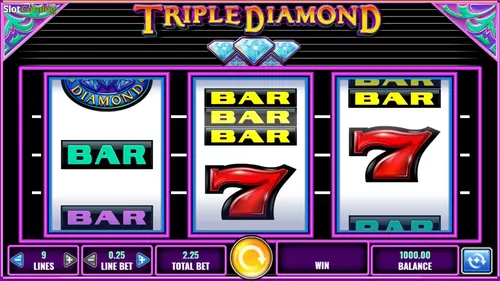
High-paying symbols
The highest value symbols in the base game are required to align on active paylines to trigger the maximum win cap of 1199x. This multiplier ceiling represents the absolute upper limit for a single spin outcome within the standard feature set. Achieving such returns demands precise alignment of premium icons without reliance on auxiliary bonus mechanisms.
Unlike Wolf Run, which offers medium volatility and a 1000x max win on five reels, Triple Diamond concentrates its payout potential on fewer spins. The 95.06% RTP suggests that high-value hits occur less frequently than in higher-return games, balancing risk against reward. Players must account for this variance when planning their bankroll management strategies.
Low-paying symbols
Standard card ranks from nine through Ace form the lower tier of the symbol matrix, providing foundational frequency for small wins. These icons appear more often than premium themes, contributing to the overall hit frequency inherent in low volatility designs. Their presence ensures continuous engagement even during dry spells between larger payouts.
The mathematical model assigns minimal monetary value to these basic symbols, keeping average bet sizes sustainable for casual players. A sequence of three low symbols yields a return significantly below the stake amount, reinforcing the role of wilds in sustaining balance. This structure prevents rapid depletion of funds during periods without significant multipliers.
Wild symbol behaviour
The Triple Diamond icon acts as a wild substitute for all regular symbols, facilitating connections that would otherwise remain incomplete. It does not replace the scatter or function as a standalone paying symbol, strictly adhering to substitution mechanics. This versatility increases the probability of completing valid payline combinations across the three available reels.
When two or three wilds participate in a winning combination, they apply multipliers up to 9x to the total payout. This stacking capability distinguishes the game from simpler slots lacking dynamic bonus features or free spin rounds. The multiplier effect directly amplifies returns on successful spins, enhancing the effective yield per wager placed.
Scatter symbol behaviour
A distinct scatter symbol triggers payouts regardless of its position on the reels, operating independently of fixed payline patterns. This mechanic allows for wins even when symbols do not align horizontally or diagonally along designated routes. Such flexibility expands the opportunities for positive outcomes beyond traditional line-based evaluations.
Triple Diamond lacks a dedicated bonus round or free spins feature, meaning scatters only award immediate cash prizes rather than entry into secondary games. This absence simplifies the player experience by removing complex trigger conditions associated with modern video slots. Returns remain tied directly to the base game math model without additional layering of risks.
Triple Diamond: key facts
| Parameter | Value |
|---|---|
| Game | Triple Diamond |
| Studio | IGT |
| RTP | 95.06% |
| House edge | 4.94% |
| Volatility | low |
| Max win | 1199x |
| Reels | 3 |
| Paylines / ways | 9 |
Reading the paytable
The IGT slot Triple Diamond features a classic 3x3 reel layout with nine fixed paylines, requiring players to consult the paytable for symbol values. This traditional structure lacks modern bonus rounds or free spins, focusing instead on straightforward line wins and wild substitutions across the grid. Beginners should note that the maximum win potential is capped at 1199x the stake, limiting large payouts compared to high-volatility alternatives like White Orchid which offers a 5x4 grid. Understanding these basic mechanics helps manage expectations regarding return frequency and payout size.
White Orchid by IGT utilizes a medium volatility profile across its five-reel setup, contrasting sharply with the low volatility of Triple Diamond. While White Orchid might trigger bonuses more frequently due to its scatter pays, Triple Diamond relies on its triple diamond wild multiplier up to 9x for significant gains. The theoretical RTP of 95.06% for Triple Diamond indicates a house edge of 4.94%, meaning players lose roughly five cents per euro wagered over millions of spins. This mathematical reality defines the long-term cost of playing this specific IGT title versus other studio offerings.
Comparing the three-reel design of Triple Diamond to the five-reel White Orchid highlights differences in complexity and winning patterns. Triple Diamond uses a simple 9-line system where matches must align left-to-right, whereas White Orchid employs adjacent matching from the leftmost reel. The lower volatility of Triple Diamond ensures smaller, more frequent wins, appealing to beginners seeking extended playtime rather than rare jackpots. Players should remember that the 1199x max win cap applies strictly to this game, distinguishing it from higher-cap titles in the same provider portfolio.
How wins are calculated
Wins in Triple Diamond are calculated based on matching symbols along any of the nine active paylines starting from the leftmost reel. A standard combination requires three identical symbols on an active line, but the triple diamond wild substitutes for all regular icons to complete these sequences. This substitution feature significantly increases the hit frequency, allowing players to form winning combinations even when key symbols are missing from the display. The presence of wilds effectively lowers the barrier to achieving payouts on each spin.
The triple diamond wild symbol also carries multipliers that scale with the number of wilds appearing on a single winning payline simultaneously. If one wild participates in a win, it doubles the payout; two wilds triple the amount, and three wilds multiply the result by nine. This mechanic allows for substantial returns on modest base wins, potentially reaching the 1199x maximum win threshold during favorable alignments. Beginners should track how these multipliers interact with the base symbol values to understand the true value of each successful spin outcome.
Unlike White Orchid which may offer complex bonus triggers, Triple Diamond calculates all winnings through direct line matches enhanced by wild multipliers. The absence of free spins means every win depends entirely on the immediate reel stop and the random distribution of symbols across the three rows. With an RTP of 95.06%, the game returns 95.06 euros for every 100 euros wagered over an extended period, reflecting the mathematical expectation. Players should view each spin as an independent event governed by this fixed return rate rather than a sequence leading to a guaranteed payout.
Line wins versus ways wins
Triple Diamond employs a traditional nine-payline system where wins are only awarded for symbols landing on specific, predetermined horizontal or diagonal paths. This contrasts with ways-to-win mechanics found in games like White Orchid, which counts any adjacent match from the leftmost reel regardless of position. By sticking to fixed lines, Triple Diamond simplifies the betting structure, allowing players to know exactly which combinations qualify for a payout on every spin. This clarity reduces confusion for beginners navigating the interface and understanding how their wagers translate into potential rewards.
The use of fixed paylines in Triple Diamond means that bets are placed per line, totaling nine units for a full activation of the reels. In contrast, White Orchid’s ways-to-win model often requires betting on multiple positions to cover all possible adjacent combinations across its five-reel grid. This structural difference impacts bankroll management, as Triple Diamond allows for precise control over exposure by adjusting bet sizes per line. Players can choose to activate fewer lines if desired, though maximizing coverage typically increases the probability of hitting a winning combination.
Understanding the distinction between line wins and ways wins is crucial for setting appropriate expectations for volatility and win frequency. Triple Diamond’s low volatility stems from its reliance on frequent small line wins rather than the sporadic larger payouts common in ways-based slots. The 95.06% RTP remains consistent regardless of the payline structure, ensuring that the long-term return is mathematically equivalent to other configurations. Beginners should recognize that while White Orchid offers more complex winning paths, Triple Diamond provides a simpler, more predictable gaming experience focused on steady engagement.
Bet size and symbol value
The betting range in Triple Diamond is determined by the coin value multiplied by the nine active paylines, allowing for flexible stake adjustments. Beginners should start with minimal stakes to familiarize themselves with the wild multiplier mechanics before increasing their investment. The 1199x max win cap indicates that even high bets yield limited absolute returns, making conservative betting a prudent strategy for managing bankroll effectively.
Symbol values in Triple Diamond vary from low-paying card suits to high-paying thematic icons, with the triple diamond wild acting as the most valuable substitute. These base values are multiplied by the total bet to determine the final payout for any given winning combination on an active payline. Unlike White Orchid which may have different symbol hierarchies across its five reels, Triple Diamond’s three-reel format keeps the payout structure straightforward and easy to memorize. Players should review the paytable to identify which symbols offer the best risk-to-reward ratio during their session.
The theoretical RTP of 95.06% implies that symbol values are calibrated to return nearly ninety-six percent of wagered money over time. This percentage includes the impact of wild multipliers, which enhance the value of otherwise modest symbol matches. Beginners should note that the house edge of 4.94% is inherent in these symbol valuations, meaning losses are statistically expected over long periods. Adjusting bet sizes does not alter the RTP, so players should focus on entertainment value rather than attempting to influence the game’s mathematical outcome through wagering changes.
Multipliers on the reels
The triple diamond wild symbol serves as both a substitute and a multiplier, enhancing wins by doubling, tripling, or quadrupling the payout depending on its quantity. When one wild appears in a winning combination, the payout is doubled; two wilds triple the win, and three wilds apply a nine-fold multiplier to the result. This feature is central to Triple Diamond’s appeal, offering the potential for significant returns on small base wins without requiring bonus rounds. Beginners should prioritize lines featuring multiple wilds to maximize the impact of this unique mechanic on their overall bankroll performance.
Unlike White Orchid which may rely on scatter-triggered bonuses for large payouts, Triple Diamond integrates multipliers directly into the base game’s core mechanics. This design ensures that every spin has the potential to deliver enhanced rewards through wild interactions, maintaining engagement without interrupting gameplay with separate bonus screens. The 9x maximum multiplier contributes to the 1199x top prize, demonstrating how these multipliers accumulate value over time. Players should appreciate this streamlined approach, which avoids the complexity of tracking separate bonus features while still offering substantial winning opportunities.
The presence of wild multipliers affects the perceived volatility of Triple Diamond, keeping it low despite the high potential of individual spins. Since these multipliers apply to any winning line, they increase the frequency of meaningful payouts compared to games where bonuses are rare. The 95.06% RTP accounts for these enhanced wins, ensuring that the long-term return remains consistent with industry standards for similar slots. Beginners should view multipliers as a tool for boosting short-term results rather than altering the fundamental mathematical expectations of the game.
Special symbols in the bonus
The Triple Diamond wild symbol acts as a substitute for all standard icons on the 3x3 grid, enabling winning combinations that would otherwise fail to form. This mechanic is central to achieving the maximum win of 1199x, as wilds can stack to create higher-paying alignments across the nine paylines without requiring additional scatter triggers. Unlike Da Vinci Diamonds which uses tumbling reels, this game relies on static wild multipliers up to 9x to boost payouts during base play spins. Players should note that no bonus round exists, so these wild interactions are the sole method for increasing returns beyond the base table values.
The absence of a free spins feature means the Triple Diamond wild remains the only active multiplier throughout the entire session, capping potential gains at 1199x per spin cycle. This limitation contrasts with IGT's Da Vinci Diamonds, which offers medium volatility and a separate tumbling reel mechanism to accumulate wins without consuming extra credits. Consequently, players relying on bonus triggers will find the experience flatter, as the house edge of 4.94% applies uniformly to every single wager placed on the machine.
Wild substitutions occur on every spin where they land, directly influencing the hit frequency by filling gaps in payline sequences that lack natural matches. The theoretical return of 95.06% reflects this consistent substitution ability over millions of trials, ensuring that low-volatility outcomes remain frequent despite the capped max win. A player betting 1 euro per line thus faces a predictable variance profile, where the wild's presence stabilizes losses compared to games with higher volatility swings.
Symbol upgrades and collections
Triple Diamond lacks any symbol upgrade mechanics or collection-based progression systems, restricting gameplay to the static 3x3 layout defined by IGT. This design choice ensures that the RTP of 95.06% remains fixed, unlike Da Vinci Diamonds where tumbling features can theoretically extend value through consecutive wins on a single bet. Without such dynamic elements, the maximum win of 1199x serves as the absolute ceiling for any single payout event on the platform.
The absence of progressive collections means players cannot accumulate partial sets to unlock hidden rewards, forcing reliance on the triple diamond wild for any significant value increase. This static structure aligns with the low volatility rating, providing smaller but more frequent wins rather than the delayed, high-value jackpots seen in other IGT titles. The house edge of 4.94% is therefore distributed evenly across all spins, with no special conditions altering the mathematical expectation of the base game.
Without upgrade paths, the paytable values remain constant regardless of spin history, simplifying bankroll management for beginners who prefer predictable loss rates. The 9 paylines offer clear winning patterns, but the lack of complex symbol interactions means players must accept the 95.06% theoretical return as the long-term average outcome. This simplicity reduces cognitive load, allowing users to focus on bet sizing rather than tracking elusive collection progress across the reels.
Grid layout and symbol positions
The game utilizes a classic 3-reel, 1-row visible grid with 9 fixed paylines, creating a straightforward visual field for evaluating winning combinations on each spin. This compact layout differs significantly from the 5x3 grid found in Da Vinci Diamonds, offering a more concentrated viewing area that highlights the importance of the central column for wild placement. The low volatility setting ensures that wins frequently involve these central positions, maintaining engagement without requiring large stake adjustments.
Symbol positions are strictly bound to the three vertical reels, with the Triple Diamond wild appearing anywhere to substitute for matching icons along the nine predefined horizontal paths. This rigid structure supports the 95.06% RTP by limiting the complexity of potential outcomes, ensuring that the house edge of 4.94% is calculated precisely against a known set of permutations. Players benefit from this clarity, as every possible combination is immediately identifiable without navigating intricate way-to-win matrices.
The 3x3 format restricts the maximum win to 1199x, a figure derived from the highest paying symbol aligned with wild multipliers on a full payline. This cap is considerably lower than the 5,000x potential of Da Vinci Diamonds, reflecting the simpler geometry and reduced number of ways to form winning clusters. Beginners appreciate this transparency, as the limited reel count makes it easier to track symbol movements and understand how the 9 paylines contribute to the overall return percentage.
Frequency of premium symbols
Premium symbols appear with a frequency calibrated to support the low volatility classification, ensuring that high-value combinations occur often enough to sustain player interest between wins. The 95.06% RTP indicates that these symbols pay out regularly over extended sessions, though the maximum win of 1199x limits the magnitude of any single reward event. This balance prevents rapid bankroll depletion while avoiding the frustration associated with high-variance slot machines that go long periods without significant payouts.
The hit rate is influenced by the 9 paylines and the substituting nature of the Triple Diamond wild, which effectively increases the apparent frequency of matching premium icons. Unlike Da Vinci Diamonds, where medium volatility might delay big wins, this game delivers smaller, more consistent returns that align with the 4.94% house edge distribution. Players betting per line will notice that premium symbols trigger wins more predictably, providing a steady stream of activity across the 3x3 grid.
Statistical analysis of the 95.06% return suggests that premium symbols contribute disproportionately to the total payout volume compared to low-value card icons. The 1199x max win cap ensures that even when these symbols align perfectly with wild multipliers, the payout remains within the bounds of the low volatility model. This predictable rhythm allows beginners to manage their session length effectively, knowing that the frequency of wins correlates directly with the fixed payline structure and wild behavior.
Paytable details worth checking
The paytable lists specific values for each symbol tier, with the Triple Diamond wild acting as the primary multiplier engine rather than a standalone high-payer. Understanding these values is crucial for interpreting the 95.06% RTP, as the table defines exactly how much each combination contributes to the theoretical return over time. The maximum win of 1199x is achieved when premium symbols align with the 9x wild multiplier, representing the highest possible payout on any single spin across the nine paylines.
Unlike Da Vinci Diamonds, which features a detailed tumbling sequence in its paytable explanations, this game’s table focuses solely on static line wins and wild substitutions. The 4.94% house edge is embedded in these values, meaning that the listed payouts are mathematically adjusted to ensure the casino retains this percentage over millions of spins. Players should verify that the 9 paylines cover all horizontal rows, as this simple structure dictates the exact calculation for every winning outcome displayed on the screen.
Checking the paytable reveals that the lowest paying symbols still contribute to the 95.06% return through frequent small wins, balancing the rare occurrence of the 1199x max win. The absence of bonus features means the table contains no scatter triggers or free spin multipliers, focusing entirely on the interaction between standard icons and the wild. This transparency helps beginners grasp the risk-reward ratio, as every potential payout is clearly defined within the fixed framework of the 3x3 grid and 9 paylines.
DemoRTP & VolatilitySymbols & PayoutsBonus FeaturesStrategyBonusesMobileDownload & AppMax WinSimilar GamesReviewFAQSitemap
Triple Diamond 2026