
Play Triple Diamond Now!
Home → Strategy
Triple Diamond Strategy
Approaching Triple Diamond sensibly
Triple Diamond is an online slot developed by IGT with a theoretical return of 95.06%. This percentage indicates the house edge sits at 4.94% over very long runs, requiring players to manage expectations accordingly. Beginners should recognize that this mathematical reality applies across hundreds of thousands of spins rather than individual sessions. The game offers low volatility, which means payouts occur more frequently but in smaller amounts.
The maximum win cap stands at 1199x the stake, a limit significantly lower than Wolf Run's 1000x potential on five reels. While Wolf Run features medium volatility, Triple Diamond’s three-reel layout and nine paylines provide a simpler structure for new players. This straightforward design helps beginners focus on understanding basic mechanics without complex bonus rounds or free spins. Understanding these structural differences clarifies why payout frequency varies between titles.
Players must accept that no cash-out button exists because Triple Diamond is a slot, not a crash game. Unlike games where timing influences returns, this title relies entirely on random number generation for each spin. Beginners often mistake slot mechanics for skill-based games, leading to unrealistic strategies. Recognizing this distinction prevents confusion and promotes a more realistic approach to playing.
Bankroll rules that hold up
A bankroll represents the specific amount of money set aside strictly for playing Triple Diamond. Beginners should define this limit before opening the game to prevent emotional spending during losing streaks. Without a fixed budget, players risk depleting funds faster than their financial situation allows. Establishing this boundary creates a clear separation between gambling funds and personal finances.
Flat betting involves wagering the same stake every round, which preserves the bankroll longer than progressive staking methods. Progressive staking raises stakes after losses, a strategy that does not change the built-in 4.94% house edge. Instead, it only shortens the time until ruin by accelerating the depletion of available funds. New players benefit from consistency rather than chasing losses through increased bets.
The 300% welcome bonus up to €2,000 plus 100 free spins provides extra playing capital for initial deposits. This offer extends the duration of play, allowing beginners to experience more spins within their defined limits. However, bonus terms usually impose wagering requirements that must be met before withdrawing winnings. Understanding these conditions ensures players do not misunderstand the true value of the promotion.
Bet sizing against volatility
Triple Diamond features low volatility, meaning wins happen frequently but rarely exceed standard paytable amounts. Beginners should adjust bet sizes to align with this characteristic to avoid rapid bankroll erosion. Higher stakes amplify losses during inevitable dry spells, even if they appear less frequent in low-volatility games. Maintaining modest bets ensures the bankroll lasts through the natural variance of the slot.
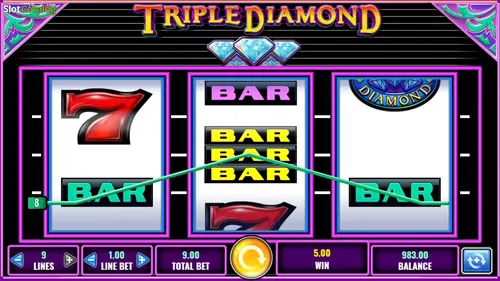
The game utilizes a classic 3x3 reel layout with nine paylines, simplifying bet calculation compared to complex video slots. Each spin outcome depends on matching symbols across these lines, including wild substitutions. Wild multipliers can reach up to 9x when multiple diamonds appear, offering occasional larger payouts. These features reward consistent play rather than high-risk betting strategies.
Comparing Triple Diamond to Wolf Run highlights how volatility impacts bet management significantly. Wolf Run offers medium volatility with a 94.98% RTP, suggesting wider swings in bankroll balance. Players accustomed to Triple Diamond may find Wolf Run’s fluctuations more challenging to sustain financially. Adjusting bet sizes according to each game’s specific volatility profile protects the overall bankroll effectively.
Session limits worth setting
Setting a time limit for each session helps beginners maintain discipline while playing Triple Diamond. Without predefined boundaries, the engaging nature of slots can lead to extended play beyond intended durations. Time limits serve as a practical tool to prevent fatigue-induced poor decision-making during gameplay. Sticking to these constraints ensures a balanced approach to entertainment and risk management.
Financial loss limits complement time controls by capping the total amount spendable in one sitting. Beginners should determine this threshold based on their disposable income rather than desired winnings. Once the limit is reached, stopping play immediately prevents further depletion of the bankroll. This practice reinforces responsible gaming habits and reduces the likelihood of regretful decisions.
Win goals provide a positive exit strategy, encouraging players to secure profits before returning to play. Triple Diamond’s maximum win of 1199x offers substantial potential for significant payouts on single spins. However, achieving this requires luck rather than strategic intervention, making predefined win targets essential. Cash out upon reaching these goals to lock in gains and preserve the original bankroll.
Why chasing losses fails
Chasing losses involves increasing bet sizes after setbacks to recover previous deficits quickly. This strategy fundamentally misunderstands how randomness operates in slots like Triple Diamond. Each spin remains independent, unaffected by prior outcomes or the size of the current stake. Increasing wagers accelerates the rate at which the bankroll diminishes under the 4.94% house edge.
Progressive staking systems promise recovery through escalated bets, yet they fail to alter the underlying mathematics. The built-in advantage favors the casino regardless of bet progression patterns employed by players. Beginners often fall prey to the gambler’s fallacy, believing past losses influence future probabilities. Recognizing this misconception is crucial for maintaining rational decision-making during play.
Triple Diamond’s lack of bonus rounds or free spins means there are no special features to offset losses. Payouts rely solely on standard symbol combinations and wild multipliers up to 9x. Attempting to manipulate outcomes through aggressive betting ignores the random nature of the game. Accepting losses as part of the entertainment cost preserves both bankroll integrity and mental well-being.
Triple Diamond: key facts
| Parameter | Value |
|---|---|
| Game | Triple Diamond |
| Studio | IGT |
| RTP | 95.06% |
| House edge | 4.94% |
| Volatility | low |
| Max win | 1199x |
| Reels | 3 |
| Paylines / ways | 9 |
Common systems and their limits
The theoretical RTP of Triple Diamond stands at 95.06%, establishing a house edge of 4.94% that remains constant regardless of betting patterns. This mathematical reality means that no progression strategy can alter the built-in advantage held by the casino over an extended playing session. Players relying on such systems often overlook that the low volatility of this IGT slot dictates frequent but smaller payouts rather than large structural shifts in expected value.
Flat betting ensures the same stake every round, which aligns with the game’s 3x3 reel layout and 9 paylines without introducing unnecessary risk to the bankroll. Unlike progressive staking methods, this approach does not amplify losses during dry spells, allowing the 1199x maximum win potential to remain accessible through consistent play. The stability of fixed wagers helps manage the 4.94% house edge more predictably over thousands of spins compared to variable bet sizes.
White Orchid offers a medium volatility profile with a 5x4 grid, contrasting sharply with Triple Diamond’s low variance and classic 3-reel design. While White Orchid’s RTP is 95.03%, slightly lower than Triple Diamond’s 95.06%, its different structure demands a distinct strategic approach for managing bankroll depletion. Understanding these differences prevents players from applying ineffective strategies across games with fundamentally different mathematical profiles and payout frequencies.
Flat betting explained
Flat betting involves wagering the identical amount on every spin, a method that pairs well with the stable mechanics of Triple Diamond’s 9 paylines. This consistency prevents rapid bankroll erosion during losing streaks, ensuring that the 95.06% RTP plays out over a longer period without premature termination. By maintaining a fixed stake, players can better anticipate the frequency of small wins generated by the low volatility setting of the IGT title.
The triple diamond wild symbol substitutes for all other icons, creating winning combinations that are amplified by multipliers up to 9x on the reels. When using flat betting, each spin contributes equally to the total turnover required for bonus activation, making the path to unlocking the 300% welcome bonus more transparent. This steady accumulation of wagered funds helps players track their progress toward the €2,000 cap without the confusion introduced by fluctuating bet sizes.
Unlike complex progression systems, flat betting relies solely on the inherent mathematics of the slot, where the house edge remains fixed at 4.94%. This simplicity allows players to focus on the entertainment value of the classic theme rather than managing intricate betting algorithms. The predictable nature of fixed stakes ensures that the maximum win of 1199x remains a distant possibility rather than a pressured expectation.
Progressive staking risks
Progressive staking involves raising stakes after losses, a tactic that increases variance and accelerates the depletion of the player’s bankroll significantly faster than flat betting. Since Triple Diamond has no bonus round or free spins, this aggressive approach offers no structural safety net to recover lost funds during extended dry spells. The low volatility of the game means wins are frequent but small, making it difficult to sustain the increased bet sizes required by such systems.
The house edge of 4.94% applies to every individual spin, meaning that increasing the wager size does not improve the probability of hitting the 9x multiplier. In fact, larger bets magnify the impact of the negative expected value, leading to quicker ruin compared to conservative staking methods. This mathematical certainty holds true regardless of the sequence of previous outcomes, as each spin on the 3x3 grid is an independent event governed by RNG.
Comparing this to White Orchid, which features a 5x4 grid and medium volatility, highlights how progressive systems fail across different game structures. White Orchid’s RTP of 95.03% also resists manipulation by betting patterns, demonstrating that no staking system can overcome the built-in casino advantage. Players seeking to preserve their bankroll should avoid progressive staking, as it only shortens the time available to experience the game’s features.
What the maths actually allows
The 95.06% RTP indicates that for every €100 wagered, the game returns €95.06 over millions of spins, leaving a 4.94% retention rate for the operator. This long-term average does not guarantee short-term results, especially given the low volatility which produces frequent but modest payouts rather than large jackpots. Players must understand that the 1199x max win is a rare outlier, not a regular expectation within the statistical framework of the slot.
Triple Diamond utilizes a classic 3-reel layout with 9 paylines, where the triple diamond wild symbol acts as the key to higher-paying combinations. The wild multipliers can reach up to 9x, but these occur infrequently due to the low variance setting designed to extend playtime. This structure ensures that the bankroll lasts longer compared to high-volatility slots, though the overall return remains anchored to the stated RTP percentage.
The absence of bonus rounds or free spins means that all returns come directly from base game spins, simplifying the calculation of expected loss per hour. With a fixed house edge of 4.94%, the cost of entertainment is predictable, allowing players to budget their sessions more effectively. This transparency contrasts with games like White Orchid, which may offer different bonus triggers despite having a similar RTP of 95.03%.
Learning the game in demo first
IGT created Triple Diamond with a simple 3x3 reel layout and nine paylines, providing a clear structure for newcomers to understand the basic mechanics without distraction. The theoretical return is 95.06%, meaning the house retains 4.94% of all wagers over millions of spins, a rate slightly higher than Da Vinci Diamonds which offers 94.93%. Players should observe how the Triple Diamond wild symbol substitutes for other icons to form winning combinations on these specific lines. This low volatility ensures frequent small payouts rather than rare large wins, allowing beginners to track their balance changes more steadily during extended play sessions.
The maximum win cap sits at 1199x the total stake, which defines the upper limit of potential returns from any single session or spin sequence. Unlike Da Vinci Diamonds that reaches 5,000x, this lower ceiling suggests a different risk profile where players might experience longer streaks of smaller gains. Understanding this mathematical constraint helps users manage expectations regarding jackpot sizes before depositing real funds into their accounts. Beginners benefit from recognizing that no bonus rounds exist here, so all action revolves around the base game mechanics and the wild multiplier effects.
Wild multipliers up to 9x activate when three diamond symbols land on an active payline, significantly boosting the payout value for that specific combination. This feature interacts directly with the 95.06% RTP figure, contributing to the overall return distribution across thousands of tested game cycles. New players often confuse this with progressive jackpots, but the 1199x max win remains fixed regardless of bet size or previous outcomes. Observing how these multipliers stack during demo mode reveals the true frequency of high-value hits within the low volatility framework established by IGT.
Adjusting stakes to your budget
Flat betting involves wagering the same amount every round, which prevents rapid depletion of the bankroll compared to progressive staking strategies that raise bets after losses. With a theoretical house edge of 4.94%, consistent small stakes allow the player to endure more spins before the mathematical advantage erodes the initial deposit completely. This approach aligns with the low volatility nature of Triple Diamond, where frequent small wins help sustain the balance during typical gameplay sessions. Users should calculate their total expected loss based on the 95.06% return rate to determine a sustainable daily playing limit.
Da Vinci Diamonds features a medium volatility setting with a 5x3 grid, contrasting sharply with the steady rhythm of Triple Diamond’s 3x3 layout and low variance. This difference means that adjusting stakes for Triple Diamond requires focusing on longevity rather than chasing the larger, less frequent payouts seen in five-reel games. Since the max win is capped at 1199x, players can safely increase bets slightly if they have a substantial bankroll, knowing the downside risk is contained. The 9 paylines remain constant, so changing the line bet directly scales the total stake per spin without altering the underlying game structure.
The 300% welcome bonus up to €2,000 plus 100 free spins provides additional capital that must be converted through wagering requirements before withdrawal is possible. Each euro wagered contributes partially to clearing these conditions, making the selection of low-volatility slots like Triple Diamond a strategic choice for meeting turnover targets efficiently. A 95.06% RTP implies that for every €100 bet, approximately €95.06 returns to the player pool, affecting how quickly bonus funds deplete during play. Beginners should monitor their remaining balance against the 4.94% house edge to ensure they do not exhaust their funds before completing the required turnover volume.
Recognising a bad session
A session becomes problematic when the bankroll drops significantly below the starting amount due to the cumulative effect of the 4.94% house edge over many spins. Unlike Da Vinci Diamonds which may offer larger swings with its 5,000x max win, Triple Diamond’s 1199x cap limits upside potential while still enforcing the same statistical disadvantage over time. Players should recognize that low volatility does not prevent losses; it only distributes them more evenly across a larger number of attempts. If the balance decreases by more than half the initial deposit within a short timeframe, the mathematical reality of the 95.06% RTP is actively working against the player.
The absence of free spins or bonus rounds in Triple Diamond means there are no special features to recover losses through enhanced multiplier opportunities or extra reels. This contrasts with Da Vinci Diamonds, which includes cascading reels and tumbling wins that can extend gameplay beyond standard spin results. Without these mechanisms, every loss is final and must be covered by future wins that are statistically unlikely to exceed the 4.94% edge consistently. Monitoring the speed at which the 9 paylines produce non-winning outcomes helps identify when the session has shifted from normal variance to unfavorable depletion.
Progressive staking systems that raise bets after losses cannot overcome the built-in 4.94% house edge and only accelerate the time until ruin occurs. Since the maximum win is fixed at 1199x, no betting pattern can guarantee a recovery of lost funds once the bankroll is critically low. Players using the 300% welcome bonus up to €2,000 must also consider that wagering requirements continue to apply even during losing streaks, draining both bonus and real money. Recognizing this financial trap early allows users to stop playing before the statistical inevitability of the 95.06% RTP fully erodes their available resources.
Stopping while ahead
Stopping while ahead requires discipline because the 95.06% RTP guarantees that long-term play will eventually return less than the total amount wagered. Even with a low volatility design, the law of large numbers ensures that the 4.94% house edge will manifest over hundreds or thousands of spins. By cashing out when the balance exceeds the initial deposit, players lock in profits that would otherwise be surrendered to the casino’s mathematical advantage. This strategy is particularly effective given the 1199x max win cap, as reaching significant multiples is rare and should trigger immediate withdrawal of funds.
Da Vinci Diamonds offers a higher max win of 5,000x and medium volatility, which might encourage players to stay longer for bigger payouts despite similar RTP concerns. In contrast, Triple Diamond’s lower ceiling and 3x3 reel layout suggest that modest gains are the realistic expectation for any sustained session. Players should set a target profit level based on the 9 paylines and stick to it, ignoring the temptation to chase further wins. The presence of wild multipliers up to 9x can create moments of unexpected growth, but these are statistical outliers rather than reliable income sources.
The 300% welcome bonus up to €2,000 plus 100 free spins adds complexity to withdrawal timing, as unmet wagering requirements may block access to winnings. Players must calculate whether their current balance covers the remaining turnover needed to convert bonus funds before stopping play. If the session is profitable, withdrawing immediately avoids risking those gains against the ongoing 4.94% house edge inherent in every spin. Using the demo mode to practice this exit strategy helps establish habits that preserve bankroll integrity without relying on luck or favorable variance periods.
Responsible play in practice
Responsible play begins with defining a strict bankroll limit that represents disposable income unaffected by essential living expenses or financial obligations. The 4.94% house edge means that every euro wagered has a predictable statistical cost, making budget adherence crucial for preventing debt accumulation. Unlike gambling on sports or table games, slot machines like Triple Diamond operate continuously, requiring players to self-impose time and spending caps. Setting a daily loss limit based on the 95.06% RTP helps ensure that sessions remain entertainment rather than becoming a source of financial stress.
Da Vinci Diamonds provides a comparison point with its 5x3 grid and medium volatility, reminding players that different games carry different risk profiles and time commitments. Triple Diamond’s low volatility and 3x3 layout may feel safer, but the 95.06% RTP remains unchanged, demanding the same level of financial caution. Players should utilize tools provided by operators to monitor play duration and expenditure, ensuring that the pursuit of the 1199x max win does not lead to excessive spending. Recognizing that the 9 paylines offer limited ways to win reinforces the need for controlled betting frequencies.
The 300% welcome bonus up to €2,000 plus 100 free spins can distort perception of value, leading players to wager more than intended to unlock rewards. Responsible gaming involves treating bonus funds as part of the total bankroll rather than free money, acknowledging that the 4.94% house edge applies equally to promotional credits. Players should regularly review their transaction history to assess whether their actual win rate aligns with the theoretical 95.06% return over time. Seeking support if gambling interferes with daily life is essential, as no slot feature, including wild multipliers up to 9x, can alter the fundamental mathematics of the game.
DemoRTP & VolatilitySymbols & PayoutsBonus FeaturesStrategyBonusesMobileDownload & AppMax WinSimilar GamesReviewFAQSitemap
Triple Diamond 2026